The Dicey Musical I Long To Write

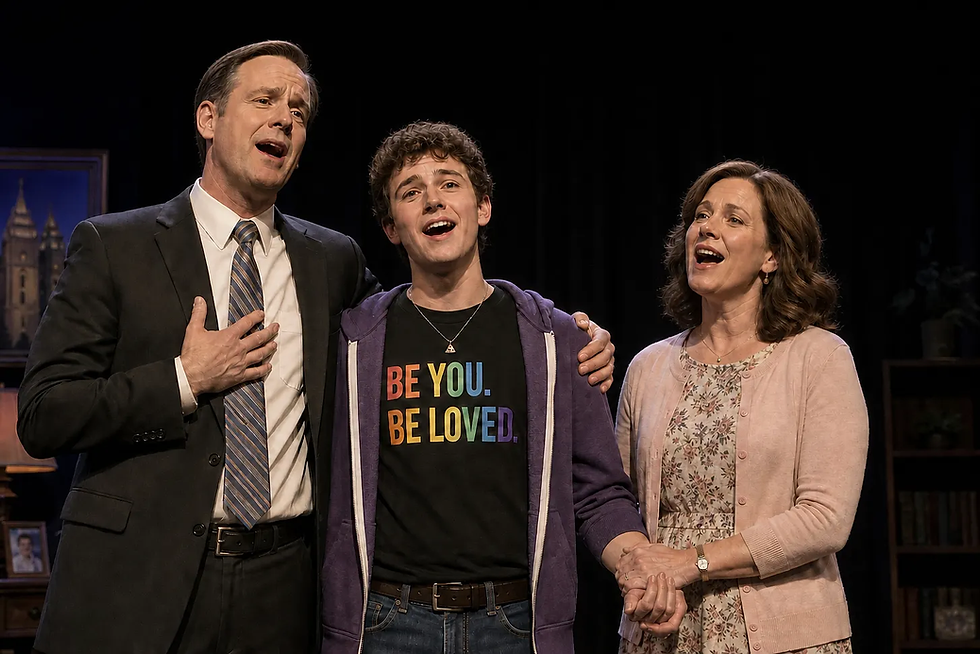
Today, I’m writing about a musical that I believe ought to be. It’s on my eager list to write (once we’ve finished the Eyes Wide Open beat sheet, and revisions to Neverland: Wendy’s Story). But first, I’ll need to find the right collaborators — with views different from my own — who are willing to tackle it. And that may not be easy. It’s a “Mormon” musical, in the way that Fiddler on the Roof is a Jewish musical – meaning that it’s richly informed by the theology of the Church of Jesus Christ of Latter-day Saints, and by the culture of church members. But I’m hoping that its appeal will be as broad as Fiddler’s, because the issues it explores have wide resonance, despite the distinctly “Mormon” flavour.
The musical is about a devout LDS couple’s wrestle with their son’s disclosure that he’s gay and needs to leave the church. It’s about that son’s wrestle with his parents’ reactions. And it’s about a lot more than that: the space between disbelief and certainty that is a growing ground for faith; the possibility that honest seekers after goodness can be led on different paths by their personal conscience; and the idea that humility may be a better guide for dealing with LGBTQ+ issues than either pride or shame.
This subject matter is scary to approach; we’re bound to offend somebody, no matter what. But I have been aching to write it for years because I think it’s needed. There are conversations here that need to happen in a way that a Summit Stages musical can make possible. And I’m writing about it now because I just listened to this podcast on Faith Matters. Dave Zimmerman, who with his wife Kirty is sharing his family’s journey with their gay son currently serving a mission, is the sound engineer who helped produce my songs “Anger” and “Biased.” The musical I envision is not based on their story. But, even though the Zimmermans’ story features a young man who has chosen to abide by the church’s standard of reserving sexual relations to heterosexual marriage, it highlights a multitude of reasons that we need to get LGBTQ+ issues on the table for loving and searching discussion.
At this point, I only have a partial outline for the musical. And I think it’s going to need to stay that way until I find the right collaborators. But here’s what I have right now.
It starts with a female Gospel Doctrine (adult Sunday School) teacher surrounded by her class as they conclude a lesson on The Family Proclamation. They are singing “All Is Well In Zion,” a celebration of the safety they find in prophetic guidance that keeps members away from destructive paths. The song is full of pitying allusions to the wicked and benighted world, and features undertones of self-congratulation for holding fast to the iron rod and staying on the straight and narrow path that leads to the tree of life.
After church, the woman has a quick check-in with her bishop husband, who will be held up in meetings for several hours, but seizes the moment to let her know he’s heard rave reviews about her lesson today. They look forward to family time this afternoon, with an “I Want” duet about their longing to be a force for good, and their expectation of a forever family with no empty chairs at their celestial table.
At lunch, as she discusses the Proclamation with their 6 kids, the eldest, 17, suddenly gets up and leaves the table. Later, he discloses that he’s gay and he can’t take it anymore. He’s never going to church again.
Thus the saga begins. Mom and Dad want to pull him back into the fold. He’s always been close to God. Being gay is not a sin. Only acting on it is sinful. They just need to help him reconcile himself to the challenge of a celibate life. Only, as they begin to listen to him, their eyes are opened to the shaming messages that keep coming his way and the anguish he experiences at church. They all three decide to keep this quiet while dad and mom work on changing church culture. It’s not safe for their son to come out of the closet right now, if ever. They hope he’ll never have to; that this is a phase he will grow out of, or he will experience a miraculous change that takes the struggle away from him.
Their son continues to feel like he’s carrying a dirty secret, fearing that his friends and leaders would reject him if they knew he was gay. He tries to reconcile himself to a lifetime of never letting himself fall in love, while exercising faith that he’ll eventually be healed and receive every blessing he could want in the eternities, if he can just endure to the end. He begins to long for death and is contemplating suicide when he experiences a profound personal assurance that God loves him as he is and he needs to learn to love himself as he is. He decides to embrace his sexual orientation as a part of himself and comes out of the closet. This creates tension at church, where Dad is trying to combat shaming without backpedalling on doctrine. The boy stops attending church and starts dating.
Both parents struggle to reconcile their son’s experience with church doctrine, while also grappling with prophetic fallibility. “Last and First” appears here.
Mom winds up in a place where she’s hoping for new revelation, like the 1978 revelation that lifted the ban on black men receiving the priesthood, only this one would permit gay marriage within the church. Dad doesn’t believe such a revelation should ever happen – it would undermine the precious doctrine of eternal families. A close friend leaves the church in protest over its non-acceptance of homosexual relationships. The son gets engaged to his boyfriend and hopes his family will celebrate his marriage with him. Mom and Dad hash that out with each other, weighing out the implications for faith, dignity and mutual respect.
In the end, none of them fully agree with each other. But every one of them grows in their respect for each other’s honesty and decision making processes. Each comes to a conviction that God has answers they don’t, and each lets go of the inclination to try and direct another’s conscience. They decide their job is to love each other, no matter how they disagree, while trusting God to be good, and to lead into light everyone that’s seeking it.
The final scene is another Gospel Doctrine lesson, where Mom is still teaching, but with a
profoundly different attitude. She asks questions like, “How do we include our LGBTQ+ members in our quest to strengthen the family?” The closing number “Til All Is Well In Zion” is about working for a day when we’ll see eye to eye, because our faith is strengthened by humility sufficient to both hear each other, and be taught from on high, line upon line.What do you think would be the impact of such a musical in your community?
If you are not LDS, do you think it would have resonance outside of its “Mormon” context?



Comments