Surprising Structure in Support of Substance

Welcome to this week’s edition of Summit Stages News! I’m Rebecca Burnham and this is where you get weekly updates about musical theatre that promotes wholeness and belonging; learn about visionary creators, producers and others; and discover some mighty stories that need to be turned into musicals.
I’m on a collaborative mission to give cynics reason to become connectors, drifters hope to become builders, and enemies understanding to become friends, all through musical theatre. It’s a task that’s way bigger than I am and this newsletter is my effort to gather with people of vision, heart, and skills so we can do that work together.
Today’s newsletter was supposed to be posted a couple of weeks ago. But at 4:00 am, I must have dozed off before pressing the publish button. And today, that mishap seems providential, because I believe the ideas we’ll explore have resonance with the results of yesterday’s midterm election in the USA. For the first time in two decades, the US President, Congress and the Senate will be in perpetual gridlock unless they decide to see themselves in each other and find a way to cooperate on bipartisan solutions. And the hope that they might does seem like an impossible dream. But, as the story of Orpheus makes clear, that doesn’t mean we shouldn’t dream it, nor that it can’t be achieved.
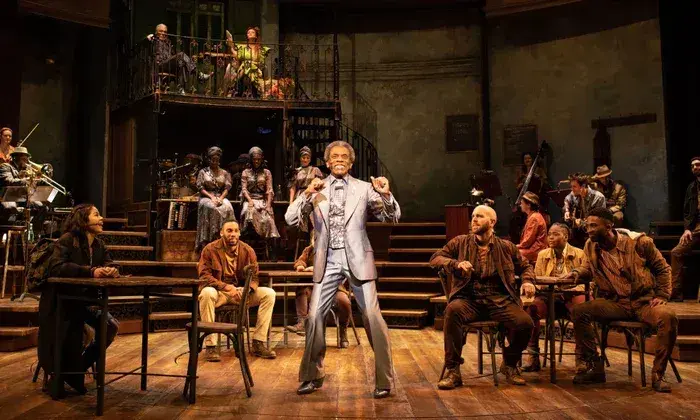
Spoiler Alert. I’m doing a deeper dive into Hadestown here. If you haven’t yet seen the show, you might want to do that before reading this exploration of how the story works, despite playing fast and loose with a number of the rules for successful stories and musicals that I’ve been writing about.
Hadestown is hard to categorize. In the opening number, Hermes tells us it’s a tragedy. Yet it feels triumphant despite the tragic ending of the central love story. And it refuses to follow the traditional outline of a tragedy. We don’t have a hero who self-destructs because of a fatal flaw that’s been with him since the beginning. Instead, we have someone who achieved the impossible thing he set out to do, fully earned his happily-ever-after, and then lost it to a fatal flaw he developed on the way to his triumph. And even that isn’t how the show ends. Instead, it closes with a return to the beginning, a more hopeful beginning, with an almost promise that maybe this time, it will turn out right.
I think there are some brilliant choices in music, costuming and choreography. For this post, though, I want to focus on its story structure and how the choices there help to carry the message home.
Save the Cat’s Beat 1, the opening image, gives us Hermes in a silver suit with most of the cast and the band seated behind him in something of a pub. We launch into “The Road to Hell” an opening number that introduces us to the world we’re about to explore and all the characters that will play a part. They are Greek gods, the Fates and a mortal chorus, plus a mortal girl and a mostly mortal boy. But it’s not set in ancient Greece. Instead, it’s a little town along an American railway, in an era that seems vaguely steam-punk, mixed with Great Depression. The contrast between the ancient tale and the more modern setting suggests that this story is to be taken symbolically rather than literally. It isn’t constrained to any time and it isn’t bound to a particular interpretation.
What’s more, Hermes breaks the fourth wall as he sings to the audience. We are clearly part of the story as well. It’s an old song, and it’s a current song, because we’re gonna sing it again. And we’re going to sing it as if maybe this time, it will turn out right. That line gives us Beat Two, the first hint of our theme: that the courage to sing a certain kind of sad but beautiful song could bring healing to our world.
What follows is a very long Beat 3 or Set-up. Orpheus may be the hero of the story, but he’s a dual protagonist with Eurydice, the woman he marries. We have two I Want songs: Eurydice’s “Any Way the Wind Blows” and Orpheus’s “Come Home With Me.” Eurydice has lost her ability to dream, so her song is more about what she doesn’t want than what she does. Meanwhile, Orpheus can’t be dissuaded from dreaming. Despite being warned by Hermes not to come on too strong, his first words to Eurydice are “Come home with me.” Then he tells her what he’s working on: “A song to fix what’s wrong, take what’s broken, make it whole. A song so beautiful it brings the world back into tune, back into time and all the flowers will bloom.”

Next we have the Conditional Love Song, “Wedding Song” where Eurydice tries to show Orpheus that he’s wholly out of touch with reality, and he answers each objection with sublime faith in the power of the Song to melt away every obstacle. It isn’t logic that wins this conversation. It’s the fact that Orpheus’s song makes a flower bloom in his hand when he’s singing. Eurydice is helpless against such gentle power, and he wins her heart.
The final important part of the Set-up is the disclosure, in “Epic I” that the melody of Orpheus’ song isn’t his and it isn’t new. It’s an ancient melody, sung long ago by Hades when he first loved and won Persephone and the two of them found a way to care across seemingly impossible differences. Their apparently conflicting needs, and their longing to belong to each other in spite of them, became the source of the seasons.
Normally, the B story would be saved to Beat 7. But Orpheus’s tale is so tightly interwoven with Hades and Persephone’s that the tensions in their relationship form an essential part of the Set Up. We see Persephone arrive on the train to bring spring. But she’s late and blazing, with a frantic edge to all her celebrations. (This is also where we get Beat 8: Fun and Games, with the lovers partying up with Persephone and vowing to stay together always.)
Now, at last, we’re ready for Beat 4, the Catalyst, which begins with the onset of winter and a closer look at the gods’ jaded discontent with each other. Frustrated with his wife, Hades tempts Eurydice into the underworld. Beat 5, the Debate, is where the protagonist hesitates before launching on a course of action that will change everthing. The Debate has to go to Eurydice, not Orpheus. She’s the one who is persuaded by the bitter wind, an empty stomach and the ever present voices of the Fates, that she has no other choice. With “Already Gone” she takes the train to Hadestown, bringing on Beat 6, the Break Into Two. With Orpheus, there is no debate. The instant he learns she’s gone, he goes after her, despite Hermes trying to talk him out of it. But “Wait For Me” is haunting and hopeful. It’s nothing like the big number that usually ends Act I. So we go to the Underworld to see Hades leading “Why We Build The Wall” and Eurydice arriving part way through to join the chorus and sign her soul away. This is Beat 9, the Midpoint, and the end of Act I.
Act II starts with Beat 10 (Bad Guys Close In). There is nothing but sorrow in Hadestown for Eurydice, and she’s mourning the loss of Orpheus when he arrives on the scene and vows to bring her home. Only, she can’t go because she’s sold herself to Hades, and that disclosure catapults Orpheus into Beat 11: All is Lost. After he’s beaten up for his troubles, the Fates arrive to rub salt in his wounds with “Nothing Changes.” Orpheus sinks into his Dark Night of the Soul (Beat 12), when he sings “If It’s True” – “Is this how the world is? To be beaten and betrayed and then be told that nothing changes? It’ll always be like this? If it’s true what they say, I’ll be on my way.”
But just then, something changes: Hades’ workers pause in their wall-building. And they listen. Orpheus sees the tiny shift and takes courage. He sings to them as well as to himself that those who try to dominate by peddling hopelessness can’t be trusted. This is his Beat 13: Break Into Three, where he uses what he has now learned to start taking productive action.
At the beginning of the story, Orpheus was a naive dreamer. Now, he’s a veteran. He has walked into the jaws of hell only to encounter betrayal, to get beaten for his pains, and to be told that stagnation and decay are the immutable law of the universe. And now, he chooses to dream and sing for something better anyway. “So I’m askin’ if it’s true. I’m askin’ me and you. And you. And you. I believe our answer matters more than anything they say,” he sings. The workers join in and he continues, “I believe if there is still a will, then there is still a way.” The work on Hades’ wall (and his factories) grinds to a halt, and the whole assemblage winds up face to face with an angry god who vows to put Orpheus to death. But first, the god orders the young man to sing.
Orpheus sings the song he’s been working on all this time, the one that was supposed to bring spring back to the world. It’s a song he was never before able to finish, because until he lost Eurydice, got brutalized, and had everything he hoped for torn from him, he was incapable of connecting with Hades. But now, he’s able to identify Hades as like himself. He sings of the love the King of Shadows once held for Persephone, and of the fear that drove him to trust in walls and machinery and cruelty, while shutting down his heart. The song reminds Hades of who he really is. He begins to weep and then to sing, and a flower blooms in his own hand. The two gods dance together, and spring has returned.
According to Save the Cat, this would be Beat 14, the Finale. But it can’t be here, because that’s not how the myth of Orpheus and Eurydice ends. What’s more, the story is symbolic, and depicted as recurring repeatedly, from ancient history to today. And we know that the world we live in is still broken, still needs to be made whole, so Orpheus’ quest is not yet complete. Hence, we watch, aghast, as he loses Eurydice just steps away from getting her safely home. But we barely pause there before we’re whisked right back to the opening scene, and watch it begin to be told anew. Hermes explains, “Cause here’s the thing, To know how it ends, And still begin to sing it again, As if it might turn out this time, I learned that from a friend of mine.”

The applause erupts and the cast begins to bow. We think the show is over. But then, there’s one more song: “We Raise Our Cups.” This is a toast to Orpheus, to the birds “who sing in the dead of night,” to the flowers “that bloom in the bitter snow,” and “to Orpheus and all of us, goodnight, brothers, goodnight.” The final image, beat 15, is the entire cast with their cups raised high. It’s a compelling contrast with the divisions between groups and the general sense of poverty and discouragement that characterized the opening number.
Hadestown suggests that our societal ills are caused by the neglect and eventual loss of human connection, and that this results in the compulsive pursuit of cold comforts that can never fill the emptiness we’ve been trying to flee. It also suggests that finding the courage to see ourselves in our enemies, to love them, and to speak (or sing) to them in a way that reminds them of their humanity, has the potential to melt walls and put an end to endless war. And finally, it invites us to sing that song in the middle of winter and despite the bitter snow.
I wonder how many of US legislators, newly elected or not, have watched Hadestown. I wonder if they can recognize their opportunity now to reach across the aisle and connect with those they’re accustomed to seeing as their opponents. Doing so would be breaking with the generally accepted rules of how things are done in Washington. But, Hadestown broke with the rules for how one writes a musical, in order to bring home a vital healing message. Will a critical mass of statesmen do the same? Might a critical mass of voters help them see their way to doing so?
I dream, like Orpheus, that we will.

Comments