Choosing Moonshots over Shooting


For good and for ill, the news cycle this week has been compelling, starting April 1st, when the Artemis II moon mission launched into space, on its first try. On board the Orion was a team of four astronauts, three from the US and one from Canada. They brought together a wealth of differing experiences and a profound respect for what each other had to offer.
That was clear during streamed events when the crew took questions from reporters and others. April 2, when Commander Reid Wiseman was asked what it was like to lead something so historic, he replied, “Well, to answer that, I’m learning from my crewmates here. I’m flying in space with two of the most skilled astronauts we have… and Jeremy, on his first day in orbit yesterday, was just getting the job done, 100%.”
It was a sentiment that would be repeated again and again. For example, when asked about what words come to mind as they contemplate their record-breaking journey into space, Christina Koch (the first woman to ever see the entire moon from space) said,
“The main word, because superlatives just don’t do it justice, is humility. We would never be here if it weren’t for so many people that came here before us.”
She then referenced Neil Armstrong, Katherine Johnson, Dorothy Vaughan, civil rights movement leaders, partners in Europe and Canada, and everyone who worked on the spacecraft and all its parts. “They all passed the record. We definitely didn’t pass the record up here alone.”

Another message they expressed in a multitude of ways was about the preciousness of our planet and everyone on it, and the importance of human connection. When asked, April 2, what message they would send to the American people, in light of all the divisions right now, pilot Victor Glover answered,
“Trust us you look amazing. You look beautiful, and from up here you also look like one thing… No matter where you’re from or what you look like, we’re all one people,... We call amazing things that humans do”moonshots’ for a reason, because this brought us together and showed us what we can do, not just putting our differences aside, but when we bring our differences together and use our strengths to accomplish something great.”
Then, on Easter Sunday, in an expletive-laden post, President Trump threatened to blow up Iran’s power and water desalination plants and its bridges if the Strait of Hormuz wasn’t opened by Tuesday at 8pm ET. He told ABC that if Iran didn’t comply, “we’re blowing up the whole country.” According to Genocide Watch, the results of so doing would be catastrophic for civilians, who would be without sanitation or adequate drinking water. Hospitals would be shut down, along with all manufacturing and most other industry, and people would be unable to flee elsewhere because the bridges would be out. An estimatee tens of thousands would die, most of them civilians.

On Monday evening, the Atemis II mission went behind the moon, so that they were out of contact with Earth for 40 minutes. Right before blackout, Glover spoke to his personal faith:
“as we continue to unlock the mysteries of the cosmos – I would like to remind you of one of the most important mysteries there on Earth, and that’s love. Christ said, in response to what was the greatest command, that it was to love God with all that you are – and He also, being a great teacher – said the second is equal to it, and that is to love your neighbor as yourself.
“As we prepare to go out of radio communication, we’re still going to feel your love from Earth. And to all of you down there on Earth and around Earth, we love you, from the Moon.
After they came around the other side, they were asked how this experience had changed their perspective on humanity’s place among the stars. Glover replied,
“Real impact is local. To see the Earth as an entire thing and look at it, this system, and to see it all at once.. the things that we can impact directly, the people that I can touch, that I can speak to, hug, and show love and gratitude toward, is the thing that I think that’s going to change and last.”
On Tuesday morning, President Trump posted on Truth Social, “A whole civilization will die tonight, never to be brought back again,” unless Iran came in line. But Tuesday night, he extended his deadline by another two weeks.
Wednesday morning, the news came in that a 2-week Ceasefire had been negotiated. By Wednesday afternoon, the Ceasefire was falling apart over differences about whether it was supposed to include Lebanon.
Also on Wednesday, the Artemis crew shared their thoughts as they prepared to return to Earth.

Jeremy Hansen said,
“We live on a fragile planet in the void of space… We’re very fortunate to live on planet Earth, and … our purpose on the planet is to find joy, the joy in lifting each other up by creating solutions together instead of destroying. And when you see it from out here, it doesn’t change that. It reaffirms it. It’s like seeing living proof of it.”
Commander Wiseman added that, in addition to their scientific mission, they felt a purpose in their broadcasts home: What we really hoped in our soul is that for just a moment we could have the world pause and remember that this is a beautiful planet and a very special place in our universe and that we should all cherish what we have been gifted.”
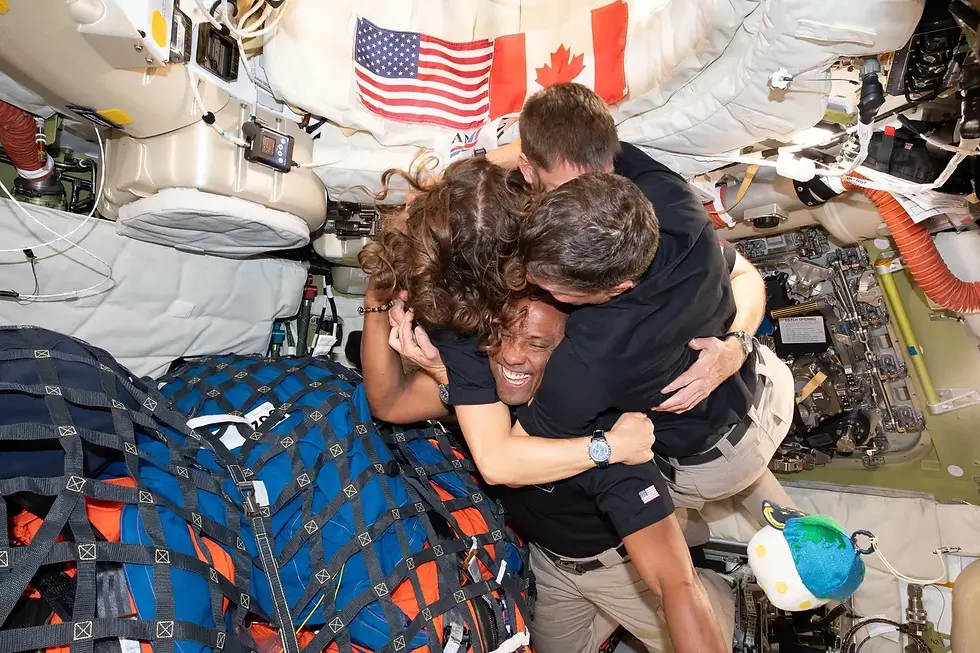
What they will miss, Koch said, is
“this camaraderie. I will miss being this close with this many people and having a common purpose, a common mission, and getting to work hard on it every day, working across 100s of 1000s of miles with the team on the ground.” And she didn’t even look forward to leaving behind the tight quarters and difficulties of living in space. “We can’t explore deeper unless we’re doing some things that are inconvenient, making a few sacrifices, taking a few risks.”
What does all this have to do with Summit Stages? I’ve just been really struck with the power in joining together across differences in a shared and daring purpose that can unite us and make use of our differences, instead of pitting us against each other. I don’t think musicals are a panacea against entrenched terrorism. But I think they could well be an extraordinary preventative. And it’s becoming more clear that right now, we need to make eager use of every tool that can effectively bring us together.
Thanks for your support for Summit Stages! If you liked this post, please consider sending it on to a friend.
If you are not already subscribed to my weekly newsletter, I'd be delighted if you'd do so here.
And a deeply, heartfelt thanks to those who've contributed to my tip jar Your support is greatly appreciated!


I remember one or more of the Apollo astronauts noting that when they looked at Earth from space, they could see no lines and no borders.
— In every place with a name
They play the same territorial game
Hiding behind the lines
Sending up warning signs
— "Territories", Rush, Power Windows, lyrics Neil Peart, 1985